Sealless Pumps for a Safer and Greener World

Choosing reliable Airport Escalator Spare Parts suppliers is not a simple price comparison. Airports demand dependable equipment, rapid support, and parts that match strict technical specifications. A faulty step chain, handrail, comb plate, or drive component can interrupt passenger movement within minutes.
This guide examines seven leading supplier options for airport escalator maintenance and replacement needs. The selection focuses on product quality, compatibility, manufacturing experience, documentation, delivery performance, and after-sales support. Suppliers with clear drawings, traceable materials, and responsive engineering teams deserve closer attention. Practical details matter, too. A correctly packaged handrail should arrive without deformation. A replacement controller should include accurate wiring information.
Reliability comes from evidence.
Maintenance managers should verify model numbers, dimensions, load requirements, and installation instructions before ordering. Independent certifications and proven airport projects can strengthen supplier credibility, but paperwork alone cannot replace field performance. Feedback from technicians often reveals problems that catalogues do not mention. Some suppliers may offer attractive prices yet struggle with urgent deliveries or technical questions.
No shortlist is perfect. Airport layouts, escalator brands, operating hours, and local service conditions vary widely. A supplier suitable for a busy international terminal may not fit a regional airport’s budget or maintenance structure. This comparison therefore offers a practical starting point, not an unquestionable verdict. Readers should confirm current specifications, warranty terms, lead times, and service coverage before making a final decision.
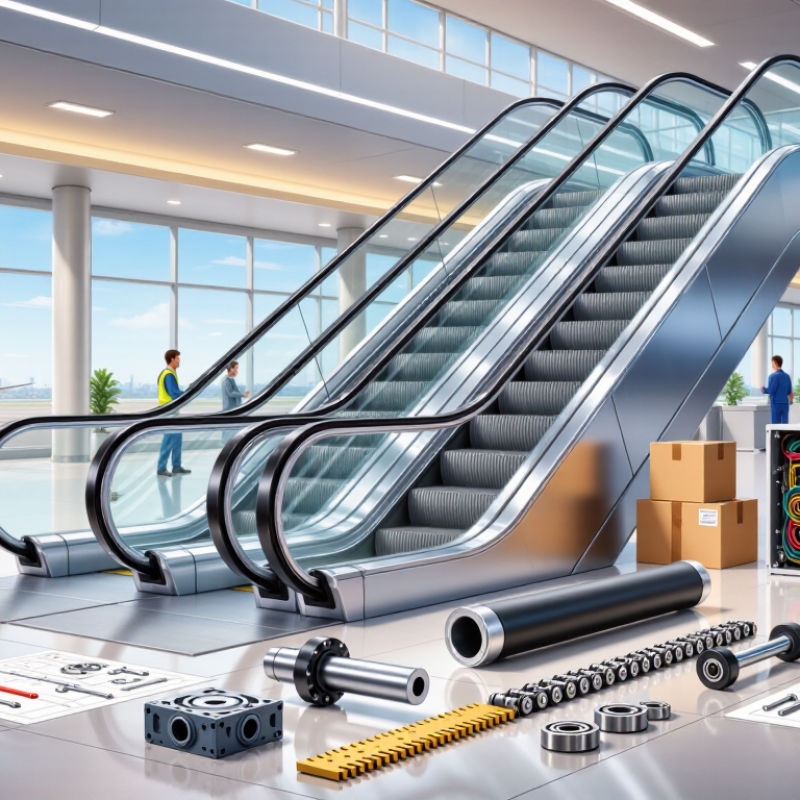
Airport escalator parts require more than quick delivery and attractive pricing. ACI World reported about 9.5 billion passenger journeys globally in 2024. That volume increases operating pressure on every step, comb plate, handrail, and brake component. Suppliers must provide traceable materials, dimensional records, and clear installation instructions. They should also understand EN 115-1 and ASME A17.1/CSA B44 requirements, depending on the airport’s jurisdiction.
A reliable supplier should support preventive maintenance, not only emergency replacement. Useful evidence includes batch numbers, load-test results, corrosion testing, and documented compatibility with the existing escalator system. Airport buyers often need parts that tolerate dust, moisture, luggage impact, and continuous daily operation. IATA’s 2024 Global Safety Report recorded an all-accident rate of 1.13 per million flights, showing how transport safety depends on disciplined systems. Escalator suppliers should apply the same discipline to inspection and documentation.
The seven best suppliers are not necessarily the largest. They are the ones that respond quickly, protect the original safety design, and provide qualified technical support. A cheaper chain or step assembly may create alignment problems later. That risk is easy to underestimate. Procurement teams should audit supplier certificates, service experience, spare-part availability, and local response times. Standards can guide selection, but field conditions still matter. A checklist may miss a tired technician, unclear drawings, or a part stored beside leaking chemicals. That deserves review.
Ranking seven airport escalator spare-parts suppliers requires more than delivery speed. Compliance must lead the scorecard. EN 115-1:2017 addresses passenger escalator design, safety distances, braking, handrails, and inspection access. ASME A17.1/CSA B44 provides parallel requirements for North American installations. Rank each supplier by certificates, traceable material records, safety-critical drawings, and documented compatibility. Give compliance 35% of the score, technical evidence 25%, airport delivery performance 20%, and lifecycle support 20%. The 2024 global elevator and escalator market report from Fortune Business Insights estimates continued market growth through 2032, increasing pressure on maintenance teams and qualified component sources.
Do not accept a generic “compatible” label. Request part numbers, revision histories, hardness results, and test reports for chains, step rollers, comb plates, switches, and brake components. Compare supplied dimensions against the original equipment drawings. A practical audit should also review emergency stock, customs documentation, packaging, and response time during night operations. The European Lift Association’s safety guidance emphasizes competent maintenance and risk-based inspection; that supports evidence-led supplier ranking rather than price-led purchasing. My imperfect view: scoring can still misjudge a supplier when airport records are incomplete.
Tips: Ask for EN 115-1 and ASME A17.1/CSA B44 evidence separately. Check certificates with the issuing laboratory. Inspect one sample before bulk approval. Keep failed samples. They reveal weak assumptions. A supplier scoring 92% should not pass if one safety-critical document remains unverifiable.
A strong airport escalator spare parts supplier must prove more than catalog depth. ACI World’s 2024 Airport Traffic Forecast estimates 9.5 billion passengers worldwide in 2024. Heavy passenger flows increase wear on chains, step rollers, comb plates, and handrail systems.
MTBF should come from field records, not promotional estimates. Ask for failure data by component, operating hours, load conditions, and maintenance history. A supplier reporting 80,000-hour MTBF may still underperform if testing excludes dust, moisture, or repeated starts. That deserves scrutiny. ISO 25745 guidance also supports measuring equipment performance through operating conditions and energy use, not isolated laboratory claims.
Lead time matters during a night closure. Request actual delivery records for standard and critical parts. Stock levels should be verified through warehouse audits, dated inventory reports, and a clear replenishment plan. SITA’s 2024 Passenger IT Insights report highlights rising passenger expectations for smoother airport journeys, making visible equipment failures more damaging to service quality. A dependable supplier should offer 24/7 technical escalation, airport-ready packaging, cross-border documentation, and remote troubleshooting. Ask who answers at 3 a.m. A phone number alone is not support. I would also compare emergency response times against MTBF, because a high MTBF does not compensate for weak recovery procedures.
7 Best Airport Escalator Spare Parts Suppliers?
The seven best suppliers are distinguished by global coverage, not attractive catalogs. A worldwide OEM-authorized supplier offers verified parts, engineering records, and multilingual support. A regional distribution network reduces delivery time near major airports. An independent escalator specialist can source discontinued components and provide practical alternatives. This option needs careful technical review.
A supplier with warehouses across Europe, Asia, and North America supports urgent repairs more effectively. Another strong choice maintains local service partners near international terminals. They can confirm dimensions, materials, and installation requirements before dispatch. A certified industrial parts distributor adds traceability through batch records and inspection reports. That detail matters when equipment operates continuously.
The seventh option is a logistics-focused supplier with customs experience and emergency shipping channels. Global reach is useful only when documentation is accurate. Buyers should check stock locations, response times, warranty terms, and replacement compatibility. Ask for samples of inspection certificates. Do not rely on website claims alone. I have seen fast delivery fail because a connector differed slightly. Airport maintenance teams should compare lead time, technical support, and lifecycle value. The cheapest quotation may create longer downtime. Supplier coverage must be tested in practice.
| Rank | Supplier Profile | Global Coverage | Airport Support Regions | Core Spare-Part Categories | Typical Procurement Model | Indicative Lead Time | Best Fit |
|---|---|---|---|---|---|---|---|
| 01 | Profile A — Global OEM-Equivalent Network | Worldwide distribution across all major airport markets | North America, Europe, Middle East, Asia-Pacific, Latin America, Africa | Drive chains, step chains, rollers, handrail components, comb plates, safety switches, control components | Framework contracts, technical cross-reference, scheduled replenishment | Stocked items: 1–3 weeks; engineered items: 6–12 weeks | Multi-airport operators requiring standardized parts |
| 02 | Profile B — European Engineering Specialist | Strong cross-border coverage with international export capability | Europe, United Kingdom, Middle East, North Africa, selected Asia-Pacific markets | Precision rollers, bearings, guide systems, brake parts, balustrade components, wear strips | Application engineering, drawing review, batch production | Standard items: 2–4 weeks; custom-machined items: 5–10 weeks | Airports prioritizing dimensional accuracy and retrofit compatibility |
| 03 | Profile C — Asia-Pacific Manufacturing Hub | Broad export coverage supported by high-volume manufacturing | East Asia, Southeast Asia, South Asia, Middle East, Oceania, Africa | Step rollers, chains, comb segments, handrail belts, switches, fasteners, covers | OEM drawings, private-label production, container or air-freight orders | Standard batches: 3–6 weeks; tooling or custom batches: 8–14 weeks | Cost-sensitive projects with repeat-volume demand |
| 04 | Profile D — North American MRO Distributor | Regional inventory with international shipping for urgent requirements | United States, Canada, Mexico, Caribbean, selected overseas airports | Safety switches, relays, sensors, rollers, bearings, lubricants, maintenance kits | MRO stock, emergency purchase orders, local technical support | In-stock items: 1–7 business days; non-stock items: 3–8 weeks | North American airports requiring rapid maintenance response |
| 05 | Profile E — Middle East and Africa Project Supplier | Project-based international supply with regional logistics coordination | Gulf states, Levant, North Africa, Sub-Saharan Africa, South Asia | Complete maintenance kits, drive components, step assemblies, safety devices, balustrade parts | Turnkey bill of materials, consolidated shipment, site-support coordination | Stocked items: 2–5 weeks; project packages: 8–16 weeks | New terminals, airport expansions, and large refurbishment programs |
| 06 | Profile F — Latin American Regional Supplier | Regional coverage with import support for specialized components | Brazil, Chile, Argentina, Colombia, Peru, Central America, Caribbean | Bearings, rollers, handrail parts, switches, electrical consumables, wear components | Local stockholding, import brokerage, preventive-maintenance packages | Local stock: 1–3 weeks; imported items: 6–12 weeks | Airports seeking local language, customs, and after-sales support |
| 07 | Profile G — Independent Retrofit and Obsolescence Specialist | International sourcing focused on discontinued and legacy equipment | Europe, North America, Asia-Pacific, Middle East, selected African markets | Legacy control boards, obsolete relays, custom rollers, special fasteners, replacement assemblies | Reverse engineering, sample matching, small-batch manufacturing | Available items: 2–6 weeks; reverse-engineered parts: 8–20 weeks | Older escalators where original parts are discontinued or difficult to source |
7 Best Airport Escalator Spare Parts Suppliers?
Supplier Selection Using ISO 25745-3 Energy and Maintenance Performance Data
Choosing among the seven best airport escalator spare parts suppliers requires more than a catalog review. ISO 25745-3 offers a disciplined way to assess escalator and moving-walk energy performance. It does not certify a supplier. It helps buyers compare measured energy behavior under defined operating conditions. Ask for test methods, operating profiles, and data traceability. A credible supplier should explain how a replacement controller, drive component, sensor, or step-chain part may affect consumption.
Energy data becomes useful when paired with maintenance evidence. Request failure histories, mean time between failures, corrective-work duration, and critical-stock availability. In an airport, a small sensor fault can close a route during a busy boarding period. Suppliers should provide compatibility records, installation instructions, inspection points, and batch identification. They should also state whether figures come from laboratory tests, field trials, or estimates. These sources are not interchangeable.
A practical selection team can score suppliers against energy results and maintenance outcomes. Compare standby consumption, start-stop behavior, component life, response time, and documentation quality. Keep the scoring transparent. One uncomfortable truth remains: a low-energy part may create more service calls if integration is poor. Conversely, a durable part may consume slightly more power. Review actual site conditions, including dust, humidity, passenger volume, and overnight operation. Recheck the decision after six months. Early assumptions are often wrong.
This anonymized benchmark compares seven supplier profiles using three practical selection dimensions: ISO 25745-3-aligned energy efficiency, operational availability, and preventive-maintenance compliance. Higher scores indicate better measured performance. The chart is a procurement comparison model and should be validated against audited airport maintenance records before supplier selection.


