Sealless Pumps for a Safer and Greener World

Viscose Machinery buyers are not choosing a single machine; they are choosing a production system. Its performance depends on how preparation, spinning, washing, drying, and finishing work together. A polished catalogue can hide awkward maintenance access or inconsistent automation. Small details matter.
Textile Exchange’s Materials Market Report 2024 estimates that global fiber production reached 124 million tonnes in 2023. The report places man-made cellulosic fibers within a much larger market dominated by other fiber types. This context matters: viscose is established, but suppliers still need to prove that their equipment fits a buyer’s product mix, output targets, and operating conditions. The figure describes the wider fiber market, not viscose machinery demand.
For global buyers, supplier comparisons should go beyond quoted capacity. Check reference installations, commissioning support, spare-parts lead times, process controls, and documented energy and water use. Ask how the supplier handles effluent-treatment interfaces and operator training. Then verify claims against technical documents and customer references, not brochure language alone. Not just price. A low-cost line may become expensive when critical parts take weeks to arrive. I would still question any comparison that ranks suppliers without matching feedstock, product specifications, and local service coverage. That limitation is easy to overlook. The seven suppliers in this guide are starting points for due diligence, not a substitute for site audits, performance guarantees, and a written review of each project’s requirements.
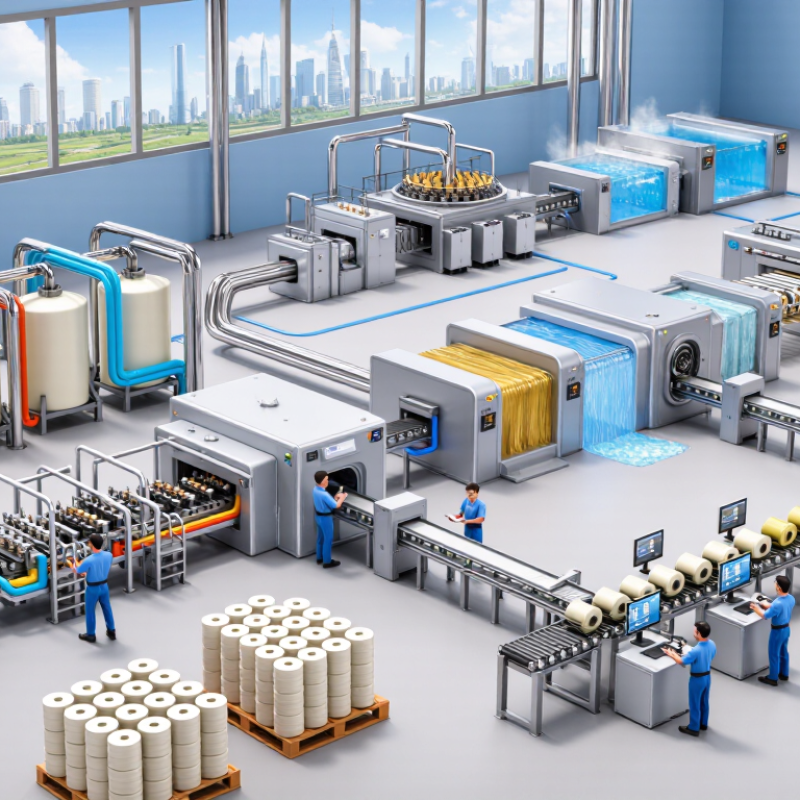
Viscose machinery turns prepared cellulose pulp into continuous regenerated fibers through a series of controlled steps. The line typically includes steeping presses, shredders, aging vessels, dissolving tanks, filters, and spinning equipment. Each stage affects the next. For example, uneven alkali distribution can create inconsistent pulp, making later processing harder to control.
Small details matter. Temperature, mixing speed, filtration quality, and solution maturity all influence spinning stability. After deaeration, viscose passes through spinnerets into a chemical bath, where fine filaments form. They are then drawn, washed, and dried. A steady flow is essential; even brief pressure changes may affect filament thickness. The process looks orderly on a diagram, but real production has fluctuations that equipment specifications alone cannot predict.
For global buyers, understanding this sequence helps clarify what a machinery supplier should explain: production capacity, material compatibility, process controls, maintenance access, and operator training. Ask how the line handles cleaning and routine adjustments, not only its rated output. Site conditions also matter, including available utilities and factory layout. There is no perfect configuration for every plant, and buyers may need to revisit initial assumptions after reviewing actual pulp quality and production targets.
Viscose manufacturing relies on connected equipment, not a single production machine. Cellulose sheets are steeped in alkali, then pressed and shredded into small, even crumbs. Aging chambers control time and temperature before the material moves to sealed reaction vessels. Consistent crumb size matters. Uneven feed can complicate later mixing.
The treated material is dissolved into viscose dope in agitated tanks. Pumps, filters, and vacuum deaeration units help remove particles and trapped air before spinning. These steps are easy to underestimate. A small filter blockage can interrupt a steady line. At the spinning stage, metering pumps push the dope through fine spinnerets into a coagulation bath, where filaments form. Bath circulation and temperature control affect thread uniformity.
Downstream machinery draws, washes, and dries the filaments before cutting or winding. Buyers comparing equipment should examine throughput, material compatibility, cleaning access, and how well each unit connects with the next. Ask for operating data under realistic feed conditions, not only ideal test runs. A polished specification sheet may not reveal maintenance demands or uneven performance during a shift. It is worth checking those details carefully.
A capability-based sourcing guide, not a named-company ranking. Equipment scope varies by plant design and product specification.
| Supplier Capability | Process Stage | Key Equipment | Primary Function | What Global Buyers Should Check |
|---|---|---|---|---|
| 1. Pulp Handling & Steeping | Cellulose pulp preparation | Pulp conveyor and feed system, steeping tanks, caustic-liquor circulation equipment | Feeds dissolving-grade pulp and immerses it in sodium hydroxide solution to form alkali cellulose. | Confirm pulp format and capacity compatibility, corrosion-resistant materials, tank access for cleaning, and process-instrumentation scope. |
| 2. Pressing, Shredding & Aging | Alkali-cellulose preparation | Presses, shredders, enclosed aging vessels, temperature-control systems | Removes excess liquor, reduces the cellulose mass to crumbs, and controls aging before the next reaction step. | Review throughput, liquor drainage and handling, temperature control, dust containment, and integration with the plant’s batch or continuous process. |
| 3. Xanthation Systems | Cellulose chemical modification | Enclosed xanthation reactors, carbon disulfide dosing and containment systems, ventilation and safety interlocks | Reacts alkali cellulose with carbon disulfide to produce cellulose xanthate. | Assess sealed handling, hazardous-area design, leak detection, ventilation, operator protection, and provisions for carbon disulfide recovery. |
| 4. Dissolving & Mixing Equipment | Viscose preparation | Dissolvers, agitated mixing tanks, liquor dosing systems, transfer pumps | Dissolves cellulose xanthate in dilute sodium hydroxide to prepare viscose dope. | Check mixing uniformity, temperature control, sealing, pump suitability for viscous fluids, and compatibility with the required production rate. |
| 5. Ripening, Filtration & Deaeration | Dope conditioning before spinning | Ripening tanks, viscose filters, filter-change systems, vacuum deaerators | Conditions the dope and removes undissolved particles and entrained air that could disrupt spinning. | Verify filtration rating and area, continuous-operation options, cleaning procedures, vacuum performance, and monitoring of dope temperature and consistency. |
| 6. Spinning & Coagulation Lines | Filament formation | Metering pumps, spinnerets, spinning cabinets, coagulation baths, bath-circulation and control systems | Extrudes viscose through spinneret openings into an acidic coagulation bath, forming regenerated cellulose filaments. | Match line design to filament type and output; check spinneret handling, bath-control capability, maintenance access, and product-changeover requirements. |
| 7. Fiber Finishing & Plant Support | Post-spinning treatment and plant services | Washing and desulfurization equipment, bleaching or finishing units where specified, dryers, cutters, balers, liquor-recovery and wastewater-treatment systems | Processes spun fiber for its intended form and specification; supporting systems can help manage process liquors, emissions, and wastewater. | Clarify which finishing steps are required for the product, water and energy consumption, emissions-control scope, wastewater interfaces, and the boundary of supplier responsibility. |
For a global project, evaluate viscose machinery suppliers against the process you need, not a polished catalogue. Define target output, fiber range, product quality, and available utilities before comparing quotations. Request a process flow diagram and equipment list that explain each machine’s role, operating conditions, and interfaces. Small details matter. Check projected water and energy use, emissions controls, and waste-treatment requirements alongside production capacity. Ask for performance data based on conditions close to your planned feedstock and product mix; headline capacity alone can mislead.
Review installation plans, commissioning responsibilities, operator training, and access to critical spare parts in your region. References from comparable plants are useful; speak with operating teams when possible. A polished presentation is not proof. Examine guarantees, test methods, exclusions, and acceptance criteria in the contract documents. Compare total ownership costs, including maintenance and expected downtime, rather than purchase price alone. For distant projects, confirm service response times and how technical support works across time zones. Ask which diagnostics operators can perform safely. A buyer’s brief can be incomplete, too; revise it when supplier questions reveal missing operating data. Some answers may remain uncertain. That uncertainty should be recorded, assigned, and addressed before equipment specifications are finalized.
Global buyers can compare seven supplier profiles by the machinery each one understands best. A turnkey line builder coordinates equipment from pulp preparation to fiber winding. Ask for a process diagram, capacity assumptions, and commissioning scope. Details matter.
A preparation specialist focuses on pulp handling, chemical dosing, and dissolving vessels. A filtration supplier designs filters that help control dope cleanliness and pressure variation. An extrusion specialist supplies spinning pumps, spinnerets, and winding equipment; request operating data for the intended fiber specification. A solvent-recovery supplier can help assess recovery equipment and utility demand. Check how its figures were measured.
The remaining profiles cover automation and field support. An automation integrator may connect sensors, drives, and control systems across older or new lines. A regional service supplier may provide wear parts, technician visits, and troubleshooting. Response times deserve verification, not assumptions. Compare reference installations, spare-part lead times, training plans, and acceptance-test criteria. One weakness in this shortlist is that supplier categories can overlap; a capable service team may matter as much as a machine’s headline speed. Ask who will be on site when the line starts.
Profiles of Seven Viscose Machinery Suppliers for Global Buyers
The chart shows the typical sequence of major viscose staple-fiber production stages, from alkali steeping to wet spinning and regeneration. The values indicate process order only; they do not represent supplier rankings, capacities, or performance.
When comparing viscose machinery suppliers, examine process stability, not brochure throughput alone. Ask for operating data on spinning-bath control, filtration intervals, washing efficiency, and fiber-break rates. Textile Exchange’s Materials Market Report 2024 estimates that global fiber production reached 124 million tonnes in 2023, with man-made cellulosic fibers accounting for about 6%. That market context supports careful capacity planning, but it does not prove any supplier’s performance.
Customization matters at the plant level. Check whether equipment dimensions, automation interfaces, and utility requirements can fit your site without costly redesign. For downstream context—not viscose-line shipments—ITMF’s 2023 machinery statistics reported 8.3 million short-staple spindles shipped, 24% fewer than in 2022. Demand can shift quickly. A supplier should explain how a proposed line can handle realistic production changes, not just ideal conditions.
After-sales support deserves equal scrutiny. Confirm commissioning coverage, operator training, spare-parts lead times, and response arrangements for remote troubleshooting. Request a clear service scope and references from comparable installations. A polished specification sheet cannot show how quickly a blocked filter gets diagnosed at 2 a.m. This matters. Supplier comparisons also have limits: reported output may use different testing conditions, so request comparable trial data before deciding.


