Sealless Pumps for a Safer and Greener World

Choosing Interactive Boards for a school is not simply a matter of comparing screen sizes and prices. It affects lesson quality, teacher confidence, student participation, and long-term technology budgets. Schools in different regions face different classroom layouts, internet conditions, language needs, and support systems. A board that performs well in a modern city campus may struggle in a rural school with unstable connectivity. That difference matters.
This guide presents ten practical tips for education leaders, teachers, and procurement teams worldwide. It considers display clarity, touch accuracy, operating systems, software compatibility, accessibility, security, installation, warranties, training, and total ownership costs. Look beyond the showroom demo. A vivid screen can hide weak microphones, confusing menus, or costly replacement parts. A short demonstration is not a real lesson.
Reliable purchasing decisions should combine manufacturer specifications with classroom experience. Ask teachers to test handwriting, screen sharing, annotation, and video playback using familiar materials. Check whether students at the back can read a small diagram. Confirm that local technicians can provide timely support. Review independent feedback where available, but treat every review carefully. Needs vary.
There is no perfect checklist. Schools sometimes underestimate training, while vendors may emphasize features that teachers rarely use. This article recognizes that limitation and encourages practical testing before approval. The right Interactive Boards should support teaching, not interrupt it. They should remain useful after the initial excitement fades, with clear maintenance plans and realistic expectations. That is the harder test.
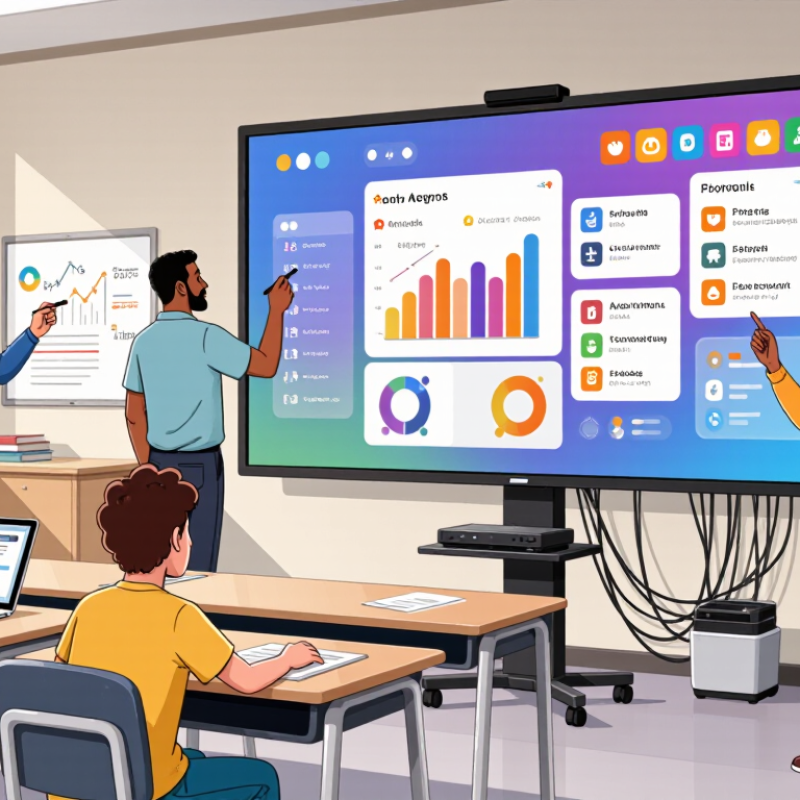
Buying an interactive board should start with learning goals, not screen size or a glossy product sheet. Start with outcomes. Ask what students must do. Will they annotate maps, model equations, compare primary sources, or practise language together? Each task creates different requirements for touch accuracy, handwriting latency, split-screen work, sound, and accessibility. A science teacher may need a bright, low-glare display for diagrams, while younger pupils need a safe, reachable writing area. Write these needs in observable terms. For example, “three students can solve a problem simultaneously” is stronger than “high performance.” That distinction prevents expensive features from replacing useful teaching.
Evidence should shape the checklist. UNESCO’s 2023 Global Education Monitoring Report notes that internet access reaches about 40% of primary schools worldwide, with major regional gaps. Therefore, a board must support offline lessons, local file playback, and simple maintenance. OECD’s PISA 2022 findings also warn that digital technology brings mixed results when use becomes distracting or excessive. Define classroom routines before choosing connectivity features. Teachers need clear controls, accessible menus, and training time, not another complicated system. Test it live. In school trials, observe a real lesson. Note glare near windows, palm rejection, audio clarity, and setup time. One uncomfortable question matters: will teachers use it weekly? If the answer is uncertain, the requirement may be training, not a larger board. That is easy to overlook.
Define the School’s Learning Goals and Interactive Board Requirements
This planning benchmark assigns a recommended percentage weight to each purchasing requirement. Learning-goal alignment receives the highest priority, while collaboration, accessibility, compatibility, durability, and staff support help schools evaluate whether an interactive board can deliver sustainable classroom value.
Display choice should follow classroom conditions, not sales-room brightness. LCD interactive panels provide sharp text and stable images in daylight. Projection systems can offer larger images, but windows and dust may reduce contrast. Direct-view LED is bright and scalable, yet its cost and fine-pixel performance require careful checking. A bright panel is not automatically better. Measure twice.
AVIXA’s Display Image Size for 2D Content standard recommends calculating image height from the farthest viewer’s distance. Therefore, compare usable image height, not only diagonal size. A 75-inch screen may suit a compact room, while a deeper classroom may need 86 inches or multiple displays. Check the rear row while seated. Small text should remain readable without leaning forward. This is often missed.
Lighting changes the decision. EN 12464-1 guidance commonly uses about 300 lux for classrooms, while direct sunlight can create stronger reflections. Ask suppliers for measured brightness, anti-glare performance, viewing-angle data, and contrast under realistic lighting. OECD’s PISA 2022 report found moderate learning-device use linked with better mathematics performance, while excessive use increased distraction. UNESCO’s 2023 Global Education Monitoring Report also warns that technology works only with teacher preparation and suitable pedagogy. Touch accuracy, speaker coverage, cable access, and repair support matter as much as resolution. My checklist still has an uncomfortable gap: local maintenance capacity is difficult to predict. Test one unit through a full lesson before ordering hundreds.
Buying an interactive board is mainly a software decision. A bright display cannot rescue unreliable classroom tools. Test common lesson files, web content, digital whiteboards, and learning platforms on the actual operating system. Confirm browser support, file-format stability, user permissions, single sign-on, and device management options. The UNESCO Global Education Monitoring Report 2023 found that only 40% of primary schools worldwide had internet access for teaching. Offline lesson access therefore deserves serious attention.
Connectivity needs a classroom test, not a showroom promise. Measure screen response while several devices connect, share content, and stream video. Check wired networking, wireless stability, guest access, port availability, and recovery after a dropped connection. The International Telecommunication Union reported 2.6 billion people remained offline in 2023. A board that requires constant high-speed internet may widen existing inequalities. That risk is easy to miss.
Accessibility should be visible during a live lesson. Look for keyboard control, screen-reader compatibility, captions, adjustable contrast, magnification, audio output, and height flexibility. Touch targets should work for students with limited motor control. The Web Content Accessibility Guidelines provide useful technical benchmarks, but compliance alone is not enough. Ask disabled learners and teachers to test the board. Their feedback may contradict the specification sheet. A perfect demonstration is still only a demonstration. Test real classrooms, older files, weak networks, and tired users before signing a purchase agreement.
Buying an interactive board for a school involves more than comparing screen sizes. Installation should begin with a room inspection. Check wall strength, viewing angles, power access, lighting, and student movement. A board placed too high can exclude younger pupils and wheelchair users. Test it live. Ask the installer to demonstrate calibration, sound levels, wireless connections, and emergency shutdown procedures. Local electrical and building requirements should guide every decision.
Training determines whether the equipment supports learning or becomes an expensive display. Request practical sessions for teachers, administrators, and technical staff. Teachers need lesson examples, annotation practice, file-sharing guidance, and methods for recovering from simple errors. Technical staff need access controls, network settings, update procedures, and diagnostic steps. Short training videos help, but supervised classroom practice is better. I have seen confident teachers struggle when training ignores real lesson pressure.
Maintenance planning should include cleaning instructions, replacement parts, software updates, and protection against accidental impact. Ask how quickly support responds, who handles remote diagnosis, and whether engineers serve your region. Written service terms matter. Keep records. A pilot period can reveal glare, weak connectivity, or confusing controls before a full purchase. One common mistake is assuming every problem needs a technician. However, unclear documentation can turn a five-minute fix into a week of disruption. Request clear manuals, reliable contact channels, and escalation procedures before signing. Review support performance after installation, because early promises may not reflect daily school conditions.
| No. | Buying Tip | Assessment Dimension | Recommended Benchmark or Requirement | Evidence to Request | Common Risk Signal |
|---|---|---|---|---|---|
| 1 | Confirm classroom fit before purchase | Screen size, viewing distance, wall strength, room layout, and accessibility | Select a display that can be read from the back of the room; verify wall load capacity and mounting compatibility before delivery. | Room measurements, mounting drawings, display weight, installation checklist, and accessibility review | A standard size is recommended without a site survey or room measurements. |
| 2 | Assess installation readiness | Power, network, cabling, mounting, ventilation, and electrical safety | Require a documented pre-installation survey and a safe cable-management plan that complies with local electrical and building regulations. | Method statement, risk assessment, cable plan, installer qualifications, and commissioning report | Installation is treated as simple plug-and-play despite wall, power, or network constraints. |
| 3 | Check regional compatibility | Electrical standards, language, keyboard layouts, software availability, and time zones | Confirm local voltage compatibility, required safety certifications, multilingual interfaces, and support coverage during school operating hours. | Compliance certificates, power specifications, supported languages, regional support schedule, and import documentation | The supplier provides generic specifications without country-specific compliance information. |
| 4 | Evaluate teacher training | Initial training, practical use, classroom integration, and onboarding materials | Include role-based training for teachers, administrators, and technical staff, with hands-on practice and recorded or written resources. | Training agenda, attendance plan, lesson-use examples, quick-start guides, and post-training assessment | Training consists only of a short product demonstration for one staff member. |
| 5 | Measure ease of daily use | Touch accuracy, writing latency, user interface, device connectivity, and accessibility | Test common classroom tasks such as annotation, screen sharing, file opening, browser use, and switching between input sources. | Live demonstration using school devices, teacher trial sessions, compatibility results, and accessibility features | The product is evaluated only through a presentation rather than representative classroom tasks. |
| 6 | Plan preventive maintenance | Cleaning, calibration, firmware updates, ventilation, and inspection frequency | Use a written maintenance schedule covering screen cleaning, connection checks, software updates, and safe environmental conditions. | Maintenance manual, inspection checklist, update procedure, cleaning instructions, and service log template | No routine maintenance instructions or responsibility assignment is included. |
| 7 | Verify warranty and spare-parts support | Warranty duration, exclusions, replacement process, parts availability, and service location | Require clear coverage for major components, documented claim procedures, and an identified source or plan for replacement parts. | Warranty terms, parts list, repair workflow, expected repair time, and end-of-support policy | Warranty terms are vague, exclude essential components, or provide no repair-time commitment. |
| 8 | Set measurable technical-support standards | Support channels, response time, escalation, remote diagnosis, and issue tracking | Define support hours, priority levels, first-response targets, escalation contacts, and ticket-status communication in the contract. | Service-level agreement, support contacts, sample ticket workflow, escalation matrix, and reporting format | Support is described only as “available” without response or resolution expectations. |
| 9 | Review security and data-management controls | User accounts, permissions, updates, privacy, network access, and data deletion | Require administrator controls, secure update procedures, documented data handling, and a clear reset or decommissioning process. | Security documentation, privacy terms, account-management guide, update policy, and data-erasure procedure | The device connects to the school network without documented permissions, updates, or data controls. |
| 10 | Calculate total cost of ownership | Purchase, installation, training, licenses, connectivity, maintenance, repairs, and disposal | Compare the full ownership cost over the planned service period rather than evaluating purchase price alone. | Five-year cost model, installation quotation, training fees, software charges, maintenance estimate, and disposal requirements | The quote excludes installation, software subscriptions, training, replacement parts, or future support. |
10 Tips for Buying Interactive Boards for Schools Worldwide?
An interactive board can look affordable until installation begins. Calculate total ownership costs over five to eight years, not just the purchase price. Include delivery, mounting, electrical work, software subscriptions, staff training, repairs, and replacement pens. Add local taxes, currency changes, and travel costs for technicians. Ask suppliers for a written cost schedule with realistic usage assumptions. Our first estimate was wrong. We forgot teacher training and annual software fees.
Warranty coverage deserves careful attention. Read every exclusion before signing. Some warranties cover the display but exclude labor, shipping, or accidental damage. Confirm response times, replacement procedures, and whether service is available in your country. Request examples of repair turnaround times from comparable school installations. Check whether critical parts remain available after three years. Keep all invoices, installation records, and service reports.
Long-term value depends on daily classroom performance. Measure start-up time, writing accuracy, brightness, maintenance needs, and accessibility features. A cheaper board may lose value if teachers avoid using it. Review expected energy consumption in classrooms with long teaching hours. Also consider training quality and technical support, because unused equipment creates no educational return. Schools should test one unit with real teachers and students before expanding purchases. Document what worked, what failed, and what still needs improvement.


