Sealless Pumps for a Safer and Greener World

Choosing the top Cooling Equipment suppliers worldwide requires more than comparing catalogues, prices, or brand recognition. Buyers need dependable performance in real conditions, from humid coastal warehouses to dusty inland factories. A unit may look efficient on paper, yet poor installation or limited servicing can quickly reduce its value.
The International Energy Agency’s The Future of Cooling reports that global space-cooling electricity demand could more than triple by 2050, rising from about 2,020 TWh in 2016 to nearly 6,200 TWh. That projection makes efficiency, durability, and grid compatibility increasingly important. The UNEP-led Global Cooling Watch 2023 also warns that cooling demand could more than triple by 2050 without stronger action. Better equipment matters.
This guide evaluates leading suppliers through practical and technical criteria. These include seasonal efficiency, heat-transfer design, refrigerant choices, controls, noise levels, warranty support, and local maintenance capacity. Field experience often exposes details that brochures omit, such as filter access, compressor replacement time, and performance during peak heat. Short-term price is not the whole story.
A ranking can still mislead.
Company data is not always comparable across regions. Some manufacturers publish detailed laboratory results, while others provide limited independent verification. Therefore, this overview combines manufacturer information with recognized industry sources, including IEA and UNEP reports. It should support careful decisions, not replace site surveys, professional load calculations, or local compliance checks. The strongest supplier is often the one that delivers reliable operation after installation, not merely the one with the largest global footprint.
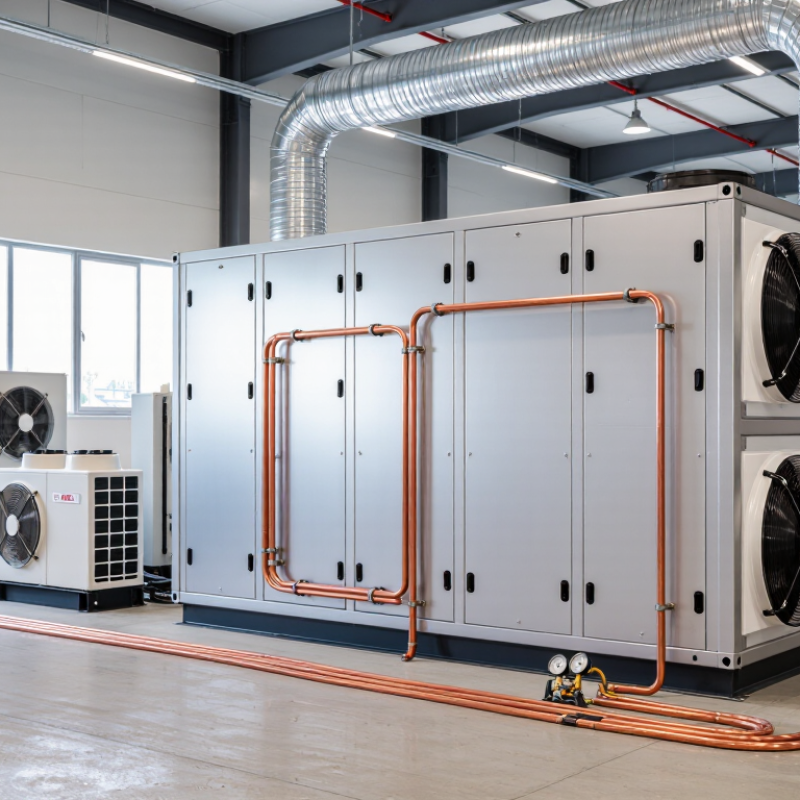
Cooling equipment removes heat from people, products, or industrial processes and transfers it elsewhere. Common systems include air conditioners, chillers, heat pumps, cooling towers, and commercial refrigeration units. A rooftop unit may cool a shop, while a water-cooled chiller circulates cold water through a hospital or factory. Refrigeration equipment keeps food and medicines within controlled temperature ranges. The categories can overlap; a heat pump, for example, can provide both heating and cooling.
Demand is rising. The International Energy Agency’s The Future of Cooling report estimated that space-cooling electricity use reached about 2,000 terawatt-hours in 2016, roughly 10% of global electricity consumption. The report also projected that global cooling demand could triple by 2050 without stronger efficiency measures. That matters in practical terms: a poorly maintained condenser coil can make a system work harder, while a well-sized unit can reduce wasted energy. Still, equipment choice depends on climate, building design, operating hours, and maintenance capacity. No single system fits every site.
Applications range from home comfort and supermarket display cases to data centres, food processing, and precision manufacturing. UNEP’s 2023 Global Cooling Watch report highlights the need to expand cooling access while reducing its climate impact. Efficiency ratings help, but they do not tell the whole story. Installation quality matters. So does refrigerant management, which can be overlooked when attention stays fixed on purchase price.
Cooling equipment removes heat for comfort, food preservation, data centers, and industrial processes. The chart shows broad, indicative nominal cooling-capacity ranges in kilowatts; actual capacities vary by design and operating conditions. Cooling towers reject heat rather than provide cooling directly to a conditioned space.
Key Factors for Evaluating Global Cooling Equipment Suppliers
A supplier’s catalogue can look impressive. The operating data matters more. The International Energy Agency’s The Future of Cooling report estimates that global energy demand for space cooling could more than triple, from about 2,020 terawatt-hours in 2016 to 6,200 terawatt-hours by 2050. Buyers should therefore compare efficiency under realistic conditions, not just headline ratings. Ask for performance at the site’s expected outdoor temperature, load profile, and water quality. Small details count: a dusty filter or undersized heat exchanger can erode promised savings.
Check service capacity, parts availability, and commissioning support across the equipment’s full working life. The IEA also highlights efficiency standards and better system design as important ways to limit cooling energy growth. Request independently verified test results, clear warranty terms, and references from installations with similar climates and duty cycles. Look closely at refrigerant choices and leak-management procedures, too. No supplier is perfect. A polished specification sheet may still leave unanswered questions about response times or long-term maintenance. Ask for those answers in writing, then compare total operating costs alongside purchase price.
Use these criteria to compare suppliers of chillers, commercial and industrial refrigeration systems, air-handling equipment, and related cooling products. Requirements and applicable standards vary by product type and destination market; verify claims against current documentation.
| Evaluation factor | What to check | Evidence or measurable data | Suggested weight |
|---|---|---|---|
| Cooling performance and efficiency | Confirm rated capacity and efficiency at operating conditions relevant to the project, rather than comparing headline values alone. | Published capacity and applicable performance metrics, such as COP, EER, SEER, or IPLV/NPLV; test conditions; certified selection data where available. | 20% |
| Product range and application fit | Assess whether the supplier can meet the required capacity, temperature range, duty cycle, installation type, and redundancy needs. | Product schedules, selection software output, operating envelope, part-load data, options, and references for comparable applications. | 15% |
| Safety, certification, and compliance | Verify that equipment and installation documentation meet the codes and regulations applicable in the destination market. | Relevant declarations, test reports, and listings; applicable electrical, pressure-equipment, and product-safety requirements; certification scope and validity. | 15% |
| Refrigerant and environmental profile | Check refrigerant type, charge, safety classification, service availability, and compliance with rules in the intended market. | Refrigerant designation and safety data; stated GWP where applicable; leakage controls; recovery and end-of-life guidance; applicable phase-down or reporting obligations. | 10% |
| Quality management and reliability | Evaluate manufacturing controls, traceability, inspection processes, and demonstrated reliability for comparable equipment. | Current quality-management certificates within scope, quality plans, factory test records, warranty terms, and documented field-performance or failure data. | 10% |
| Service coverage and spare parts | Determine how commissioning, maintenance, troubleshooting, and parts supply will be delivered at the installation location. | Named service channels, technician training, escalation process, parts availability and quoted lead times, maintenance requirements, and response commitments. | 10% |
| Delivery and project execution | Review the supplier’s ability to coordinate engineering, production, shipping, installation interfaces, and commissioning milestones. | Project schedule, stated manufacturing lead time, delivery terms, packaging and export documentation, installation drawings, and commissioning plan. | 8% |
| Controls and system integration | Check compatibility with the facility’s control strategy, monitoring platform, and required communications interfaces. | Controls sequence, available protocols and interface details, alarm and trend capabilities, cybersecurity documentation, and integration requirements. | 7% |
| Lifecycle cost and commercial clarity | Compare expected ownership costs and contract conditions, not purchase price alone. | Equipment and installation scope, energy assumptions, maintenance needs, warranty exclusions, payment terms, and documented lifecycle-cost assumptions. | 5% |
Suggested scoring method: Score each factor from 1 (insufficient evidence or poor fit) to 5 (strong, verifiable fit). Multiply each score by its suggested weight and add the weighted results to compare shortlisted suppliers.
Note: Weights are a sample evaluation framework, not an industry ranking. Confirm certificates, performance ratings, and regulatory requirements with the relevant issuing body or authority for the specific product and market.
Cooling equipment suppliers differ by region because climate, infrastructure, and service networks shape what buyers need. In humid coastal areas, corrosion-resistant coils and reliable drainage matter. In hot, dry regions, dust protection and easy filter access can reduce maintenance problems. Local technicians are valuable. A unit may look suitable on paper, yet spare parts can take weeks to arrive.
Product category matters just as much. Commercial buildings often need chillers, cooling towers, or packaged rooftop systems sized for changing occupancy. Food storage operations usually prioritize steady temperatures, clear monitoring, and dependable backup capacity. Industrial sites may require process cooling that handles variable loads and continuous operation. Ask suppliers for performance data under conditions close to your own, not only headline efficiency figures.
Look beyond the equipment itself. Check installation experience, warranty terms, commissioning procedures, and the availability of routine service. Request references from similar facilities, then ask what went wrong as well as what worked. That question can reveal useful details. Supplier comparisons are not always neat; published specifications may use different test conditions, and service quality is harder to measure. A careful shortlist should reflect local operating realities, product fit, and support after delivery.
Cooling technology is changing under pressure from rising temperatures, electricity costs, and tighter efficiency targets. The International Energy Agency’s The Future of Cooling report estimates that global energy demand for space cooling could more than triple by 2050 without stronger efficiency measures. That shift is pushing suppliers to improve compressors, heat exchangers, and system controls—not just increase cooling capacity.
Small design choices matter. Variable-speed compressors adjust output as room temperatures change, while better heat exchangers transfer heat using less electricity. The IEA report also projects that the number of air conditioners could rise from 1.6 billion units in 2018 to 5.6 billion by 2050. More units make refrigerant selection increasingly important. Lower-global-warming-potential refrigerants can reduce climate impact, but equipment must be designed and serviced carefully to maintain safety and performance. There is no simple swap.
Digital controls add another layer. Sensors can track temperature, humidity, and occupancy, then fine-tune cooling rather than run equipment at full power. In large buildings, thermal energy storage can shift some cooling production to off-peak hours. The UNEP-led Global Cooling Watch 2023 report finds that efficient, climate-friendly cooling could cut projected 2050 emissions from the sector by at least 60 percent. Promising, but not automatic. Poor installation or weak maintenance can erase part of those gains.
Selecting a cooling equipment supplier worldwide requires more than comparing catalogue prices. The International Energy Agency’s The Future of Cooling report estimates that global energy demand for space cooling could more than triple by 2050. That makes efficiency, serviceability, and operating conditions important parts of any supplier assessment. Ask for tested performance at the temperatures and humidity your site actually experiences, not only ideal laboratory conditions.
Check whether the supplier can document seasonal efficiency, refrigerant specifications, noise levels, and expected maintenance intervals. The U.S. Department of Energy’s commercial refrigeration guidance also emphasizes that equipment efficiency depends on installation and maintenance, not just the unit itself. Request references from facilities with similar loads, and examine response times for spare parts. A technician waiting days for a common fan motor can cost more than a modest purchase-price saving.
Look closely at commissioning support and warranty exclusions. Clarify who handles controls integration, staff training, and performance checks after startup. Ask for written service coverage in your region, including realistic lead times. Details matter. A polished brochure may hide gaps in local support; paperwork does not guarantee a smooth installation. Compare total ownership costs over the expected service life, while allowing for energy prices and workload changes. No supplier can predict every operating issue, so leave room for independent verification.


